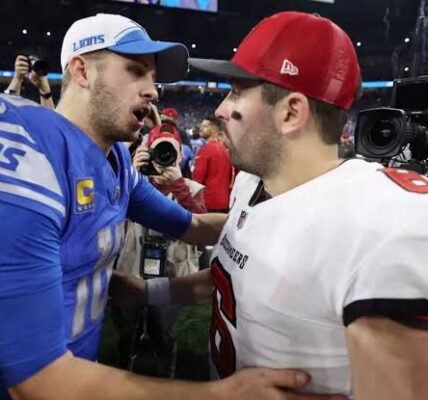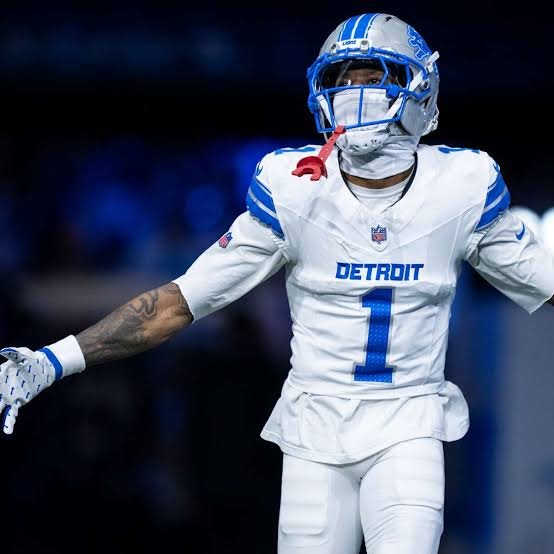
The Lions are seeing Jameson Williams develop into the star they expected.

The Detroit Lions wideout faced one setback after another to start his career. His torn ACL in the 2021 national title game at Alabama wiped out his rookie offseason and kept him sidelined for the first 11 games of 2022. Then a gambling-policy suspension at the start of 2023 delayed his momentum even longer, keeping him out of Detroit’s first four games and making it tough for him to regain his footing in the offense afterward.
There were glimpses of the explosive playmaker Detroit traded up to draft in 2022, but they mostly used him in a limited, specialty role.
That changed in 2024. Williams finally broke through, hauling in 58 passes for 1,001 yards and seven scores as part of one of the most productive offenses the league has ever seen. The Lions showed their faith in him soon after, giving him a three-year extension worth up to $83 million before the current season.
Still, Amon-Ra St. Brown remained the clear No. 1 option. Williams was dangerous, but the perception was that he was more of a vertical threat than a fully rounded receiver.
His recent play has rewritten that narrative.
“He’s turning into exactly the player we always believed he could be,” Jared Goff said after Detroit’s 44–30 win over the Cowboys on Thursday. “Right now, he’s as dependable as anyone I’ve played with. Third down, fourth down—doesn’t matter. He’s going to show up.”
Williams has begun to look like a true WR1, and not just because he switched jersey numbers. When St. Brown left the Thanksgiving game against the Packers with an early injury, Detroit needed someone to take over.
Williams answered with a career-best seven catches for 144 yards and a score—his first real game as the focal point of the passing attack.
With St. Brown back against Dallas, Williams again posted seven receptions, this time for 96 yards, showing he can produce both with and without Detroit’s top receiver sharing the field.
A major reason is the work Williams put in during the offseason. He sharpened his route running and committed to becoming a complete receiver, not just a burner who forces defenses to account for his speed.
“I run all the same routes everyone else runs,” Williams said this week. “People think I’m just running go balls, but I’m doing everything.”
That elite speed is still his calling card—defenses play him like a threat to score on any snap—but now he’s punishing teams for overplaying the deep ball. His improvement in the intermediate game may be the biggest leap he’s made.
Against both Dallas and Green Bay, Williams looked polished and versatile. He snapped off crisp comeback routes, created space on crossing patterns, and made plays in the short game, including a spectacular screen-pass touchdown on Thanksgiving where he broke loose after an incredible tackle shed.
He’s using the middle of the field like never before, and it has elevated his impact.
Of course, the season hasn’t been flawless. Williams had six games with two or fewer receptions, and the Lions openly acknowledged they needed to get him more involved. Offensive coordinator John Morton even said he “failed” Williams in October. But since a no-catch outing against the Giants two weeks ago, he has looked revitalized.
If this is the version of Williams Detroit gets moving forward, the team will have two receivers with WR1-level talent locked in through 2028—and Williams won’t carry a cap hit above $14.5 million until 2029. An extension many questioned earlier in the year might end up being one of the franchise’s smartest moves.
Time will determine whether this surge becomes his long-term norm, but Williams finally appears to be moving past the bad breaks that slowed his development. And with his infectious energy and naturally charismatic personality, “Jamo” could become even more beloved in Detroit.
As Williams himself recently put it, “If I’ve got space, I feel like there’s a 99.999% chance I’m scoring.”