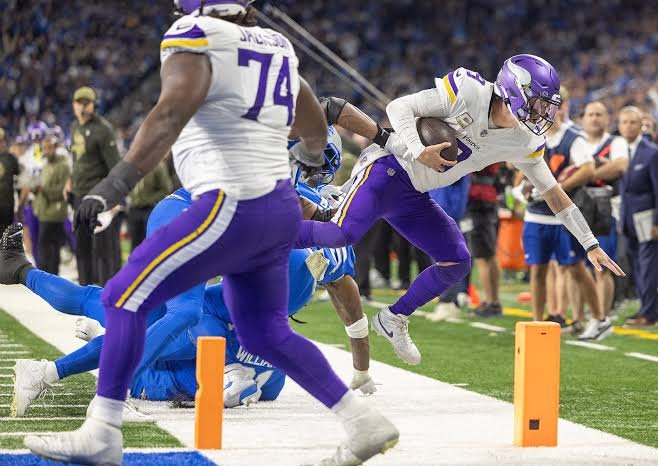

For the first time in four years, the Minnesota Vikings played with the lead at Ford Field, which helped them minimize the risks for quarterback J.J. McCarthy and neutralize Detroit’s running back, Jahmyr Gibbs.
When tight end T.J. Hockenson caught a touchdown pass from McCarthy to give the Vikings a 14-7 lead in the first quarter, it marked a significant turning point. It was the first time since December 2021 that Dan Campbell’s Lions were trailing at home in a game, while Kevin O’Connell’s Vikings found themselves in an unfamiliar, but advantageous position of holding a lead in Detroit.
Minnesota’s general manager, Kwesi Adofo-Mensah, had mentioned in the offseason that he wanted to build a team capable of succeeding in a variety of situations — whether that meant winning shootouts or grinding through low-scoring, tough matchups. Up until this point in the season, however, the Vikings had been more accustomed to playing catch-up. Prior to this game, they had only played 64 snaps with the lead, among the fewest in the league, and hadn’t been in front since their dominant win over the Bengals on September 21.
However, against the Lions, the Vikings quickly shifted the narrative. Their defense allowed a touchdown on Detroit’s opening drive, but responded with back-to-back touchdown drives of their own to seize the lead. From there, the Vikings were in control, running 43 offensive plays with the lead while their defense, which had rarely been in that position this season, had the opportunity to play with a different mindset. They were able to pressure Lions quarterback Jared Goff, sacking him a season-high five times and forcing him into 18 pressure situations. They also contained Gibbs, limiting his ability to contribute as both a rusher and a pass protector.
For McCarthy, having the lead allowed the game to slow down for him, making it easier to manage risks and decisions. O’Connell noted that the game’s change in complexion was crucial for him as a coach, especially in a place like Ford Field where the momentum could easily shift against you. He acknowledged that the ability to play with the lead helped him make different strategic decisions, such as opting for a more conservative approach on fourth downs instead of pressing risky plays.
I n addition to providing a cushion for McCarthy, the lead allowed the Vikings to lean more heavily on their running game, which gained 142 yards on 29 attempts. The lead also gave the defense the upper hand, especially in the second half, when they played with a 10-point advantage for a majority of the time. This advantage enabled them to execute a more effective game plan, ensuring the Lions couldn’t mount a serious comeback.
Ultimately, the Vikings’ ability to take control early and play with the lead proved to be a game-changer, allowing them to manage risks more effectively and capitalize on their defensive pressure to secure an upset victory over Detroit.