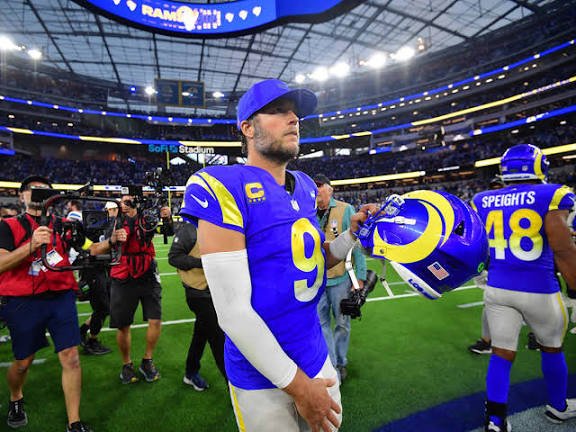

Los Angeles Rams quarterback Matthew Stafford has put together an elite body of work during the 2025 NFL season, yet his MVP case continues to face skepticism.
A growing number of voices believe Buffalo Bills quarterback Josh Allen should move ahead of Stafford in the race, largely because of Allen’s ability to impact games with his legs.
There is room for debate over which quarterback ultimately deserves the award, but the way that debate is being framed has become deeply flawed. Too often, Stafford’s strengths are dismissed or minimized, while Allen’s talents are elevated simply because they are more visually dramatic.
Understanding the Debate
Josh Allen is undeniably one of the most physically gifted quarterbacks in football. His athleticism and improvisational ability allow him to generate offense in ways few others can.
That creativity has become the centerpiece of his MVP argument.
But this raises an important question for voters: if Allen is celebrated for maximizing his unique skill set within an offense designed to highlight it, why isn’t Stafford receiving the same appreciation for excelling at what he does best?
Stafford operates within a system built around precision, timing, and efficiency. The difference is that efficiency doesn’t always jump off the screen. Allen’s style grabs attention because his movement alters defensive structures in obvious ways, forcing defenders to account for his presence as both a passer and runner.
Stafford, meanwhile, influences defenses more subtly. He controls coverages with his eyes, manipulates safeties, and creates throwing windows using anticipation and deception—often before defenders even realize what’s happening. His famous no-look passes aren’t for show; they are tools used to gain leverage in tight spaces.
So if both quarterbacks are leveraging what makes them unique to produce winning football, why should one style be valued more than the other?
Breaking Down the Numbers
The statistical comparison further complicates the argument against Stafford. He has accumulated more passing yards than Allen has total yards, holds a touchdown advantage, and has thrown significantly fewer interceptions despite attempting far more passes.
The Rams’ offensive philosophy also matters. Los Angeles doesn’t rely on quarterback sneaks or designed runs near the goal line, which naturally limits Stafford’s rushing touchdown totals. That context often gets ignored when raw numbers are compared.
Given that, what exactly about Allen’s self-created offense outweighs Stafford’s efficiency and ball security?
The Historical Context
The MVP discussion ultimately comes down to whether Josh Allen has done enough to override historical precedent.
Stafford now joins a very exclusive group in NFL history—only four quarterbacks have recorded at least eight games in a single season with three or more passing touchdowns and zero interceptions. The others? Tom Brady in 2007 and Aaron Rodgers in 2014 and 2020. In each of those seasons, the quarterback won league MVP.
If history matters—and it usually does—what has Allen accomplished this season that warrants breaking from that standard?
Arguments about supporting casts fall flat as well. Allen benefits from one of the league’s most productive running backs, an elite tight end, and continuity along the offensive line. Roster construction can’t be selectively applied only when it’s convenient.
It’s also worth remembering that last season’s MVP wasn’t even named a first-team All-Pro. Stafford is on track to earn that distinction in 2025, which raises a larger question: do we really want to continue a trend where MVP voting feels disconnected from established benchmarks?
The Bigger Picture
Josh Allen is an outstanding quarterback, and his accomplishments deserve respect.
This isn’t an indictment of his talent—it’s a critique of how MVP criteria are being applied.
Stafford’s so-called flaw is that he no longer plays like a quarterback in his mid-20s. He isn’t outrunning defenders, but he is still dissecting them.
At 37, he has guided the Rams back to the postseason and delivered one of the most efficient seasons we’ve seen in years.
The league has a history of overlooking deserving players due to shifting narratives and stylistic bias. Allowing age or aesthetics to overshadow performance would be another example of that mistake.
That shouldn’t happen in 2025—at least not if the award is truly about value.