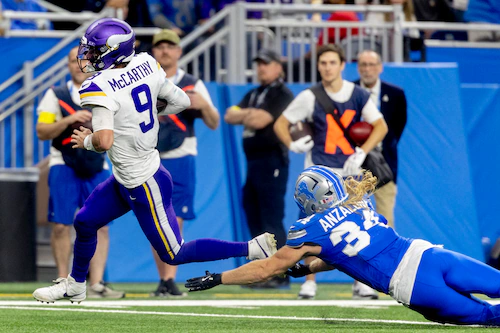

Finish unwrapping gifts and surviving holiday gatherings, because the Detroit Lions are spending Christmas on the road in Minnesota.
Detroit enters the matchup at 8-7, squaring off against a 7-8 Vikings team with everything on the line.
The Lions must win their final two games and hope Green Bay drops its remaining contests to sneak into the playoffs. That is the lone path for Detroit to reach the postseason for a third straight year.
With two games still to play, there are plenty of storylines to break down. Here are the three biggest questions heading into Sunday.
Is Detroit better prepared for Minnesota’s heavy blitz approach?
The short answer: it wasn’t earlier this season, and the challenge may be even tougher now.
When the teams met in Week 9, Minnesota overwhelmed Detroit’s interior blocking. The Lions struggled badly up front, and running back Jahmyr Gibbs had a particularly rough outing in pass protection.
By the end of that game, the Vikings had racked up five sacks, 10 hits on Jared Goff, and 21 total pressures. Gibbs alone surrendered seven pressures and a sack on just 15 blocking snaps — a performance that ranked among the worst by a running back in several years.
With uncertainty at center — whether Graham Glasgow or Kingsley Eguakun gets the nod — Detroit’s offensive line faces one of the league’s most aggressive defensive schemes.
Minnesota blitzes at a significantly higher rate than any other team, nearly eight percentage points more than the next closest defense. Defensive coordinator Brian Flores relentlessly attacked Detroit’s interior in the first meeting, repeatedly sending defenders through the middle.
The Lions’ running game hasn’t helped lately, either. Over the past two contests, Detroit has totaled just 85 rushing yards, including a brutal 15-yard performance against Pittsburgh.
As a result, Goff has dropped back 95 times in those losses — a recipe for trouble against a pressure-heavy opponent.
Head coach Dan Campbell said the focus this week is cutting down mistakes across the board. That includes improved pass protection from running backs, tight ends, and linemen, along with using chips, quick releases, and faster-developing plays to neutralize the rush.