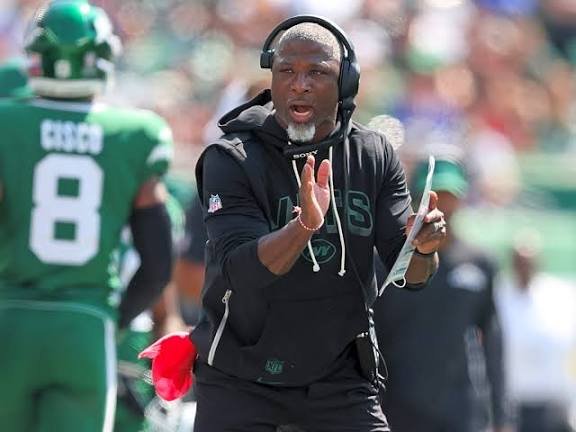

Aaron Glenn’s arrival in New York once looked like a natural fit. Now, a year into his tenure as Jets head coach, that optimism has faded as the former Lions defensive coordinator runs headfirst into the realities of one of the NFL’s most unstable franchises.
When Glenn officially took over the Jets last offseason, he wasted no time establishing an edge. His introductory message was blunt, intense, and unmistakably confident. He warned players that change wouldn’t be comfortable, but insisted the team was built to handle adversity, leaning heavily on the idea that wearing a Jets uniform should mean embracing pressure rather than avoiding it.
That hardline approach showed up immediately in how Glenn handled quarterback Aaron Rodgers. Glenn made it clear that reputation and résumé wouldn’t earn anyone special treatment, a stance that didn’t sit well with Rodgers but resonated with others in the locker room. Glenn was trying to import the accountability-driven culture he’d helped build in Detroit to the organization that drafted him years earlier.
Still, cultural overhauls take time—and Glenn knew that. What he likely didn’t expect was just how little tangible progress would show up during his first season.
The Jets stumbled to a 3–14 record, digging themselves into a hole early with seven straight losses. Midseason, the team briefly showed signs of life, winning three of five games and at least appearing competitive. That progress evaporated quickly. New York closed the year with five consecutive defeats, all of them lopsided. Those final losses came by an average margin of more than three touchdowns, leaving the Jets outscored 188–54 over that stretch and fueling speculation that Glenn’s job could already be in jeopardy.
Despite the noise, Glenn was retained. But survival came with consequences. The coaching staff has undergone major surgery, including the dismissal of offensive coordinator Tanner Engstrand. Glenn also fired defensive coordinator Steve Wilks late in the season, and the subsequent search for a replacement has been complicated by Glenn’s stated desire to take over defensive play-calling himself.
ESPN’s Rich Cimini detailed many of the internal and external factors that contributed to the Jets’ disastrous year. Some circumstances were entirely outside Glenn’s control, including the passing of former Jets center Nick Mangold and the shocking shooting of cornerback Kris Boyd in Manhattan. Cimini also described a rookie head coach learning on the job while still managing to keep players engaged during the week, even as losses mounted.
One player summed it up plainly after the season ended: the issues went beyond coaching. According to that starter, the roster simply wasn’t good enough.
Not everyone sees it that way. A longtime NFL executive interviewed by Cimini was far less forgiving, criticizing Glenn’s decision-making from the outset. The former general manager questioned both the switch at quarterback—from Rodgers to Justin Fields—and the hiring of Wilks, arguing that a coach with a defensive background should have been more decisive and effective when building his own staff.
In that executive’s view, the cultural transformation Glenn promised never materialized. Toughness and swagger were talked about but rarely visible on Sundays, replaced instead by what he described as a roster going through the motions.
When losing becomes constant, even the strongest messages lose their impact. Pair a thin talent pool with fading belief, and the result looks a lot like the Jets’ late-season collapse.
Ironically, Glenn has seen this movie before. He was part of a Lions staff that finished a head coach’s first season with momentum, only to struggle early in Year 2 before finally turning the corner. Some observers still believe Glenn could ultimately be a stronger head coach than fellow former Lions coordinator Ben Johnson. But their first seasons could not have gone more differently.
That contrast reinforces a familiar truth in the NFL: where you land matters. While Chicago wasn’t exactly stable before Johnson arrived, the Jets have been entrenched in dysfunction for years. Glenn may yet prove capable of reversing that trend—if ownership allows him the time.
If not, he risks becoming just another promising coach swallowed up by the chaos that has long defined Gang Green.