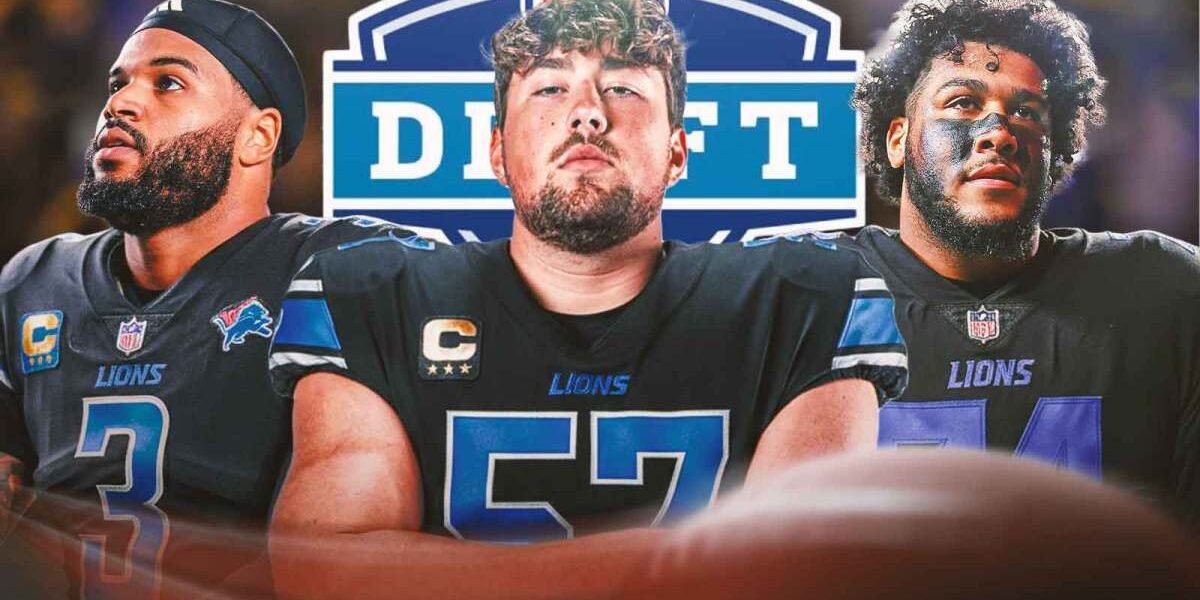
Three Detroit Lions Starters Under Pressure One Month Before the 2026 NFL Draft

Detroit Lions general manager Brad Holmes has earned widespread praise for his drafting success, particularly the remarkable 2023 class that helped reshape the roster. Still, he cannot rely solely on past achievements. Because that group produced so many impact players, the team has been limited in how aggressively it could spend during free agency.
Major contract extensions are likely approaching for several young standouts, including Jahmyr Gibbs, Jack Campbell, Sam LaPorta, and Brian Branch. While those are positive challenges to deal with, they also make it clearer where Detroit still needs to strengthen its roster heading into the 2026 NFL Draft.
At the same time, the Lions’ last two rookie classes have not delivered the same level of impact as the 2023 group. As a result, some players from those drafts—along with a few veterans already on the roster—cannot assume their roles are locked in as the team prepares for April.
Below are two projected starters for 2026 who could face legitimate competition from incoming rookies.
CB Terrion Arnold
Arnold, a first-round pick in 2024, dealt with a difficult season due to injuries. A serious shoulder issue followed by a concussion that ended his campaign prevented him from taking the developmental leap many expected in his second year.
Looking strictly at the numbers, his coverage performance was not as poor as some critics suggest. According to Pro Football Focus data, Arnold allowed just a 56.1% completion rate and an opposing passer rating of 88.6. However, discipline remained an issue. The aggressive cornerback was flagged six times during the season after drawing ten penalties during his rookie year.
Arnold clearly possesses the athletic tools and competitive mindset teams look for at the position, but the consistency has not yet materialized. With the upcoming draft widely considered strong at cornerback, Holmes could decide to add another high-upside player early.
Detroit already spent premium selections on Arnold and fellow defensive back Ennis Rakestraw Jr., yet neither has firmly established himself as a long-term answer. One scenario could involve the Lions moving down from the No. 17 pick and selecting a player such as Colton Hood of Tennessee Volunteers football, a corner known for his strong man-coverage ability and polished technique. Hood also comes from an NFL lineage—his uncle, Roderick Hood, spent nine seasons in the league after playing at Auburn Tigers football.
LG Christian Mahogany
Things can change rapidly in the NFL. Mahogany entered the league as a sixth-round selection in 2024 and quickly worked his way into the starting lineup last season. Unfortunately, his momentum was interrupted when he suffered a broken leg that placed him on injured reserve after 11 games.
Now heading into the third season of his rookie contract, Mahogany finds himself surrounded by uncertainty on what was once considered one of Detroit’s most stable units—the offensive line.
In one potential draft scenario, the Lions could trade down and select Kadyn Proctor from Alabama Crimson Tide football. Proctor has the versatility to play either tackle or guard. If he were inserted into the lineup, it could trigger a reshuffling that moves Penei Sewell to left tackle, pushes Taylor Decker out of that role, and allows free-agent addition Larry Borom to take over at right tackle.
In that situation, Mahogany could become the player squeezed out of the starting five. It is also possible that Holmes prefers to invest higher draft capital at guard rather than relying on a late Day-3 pick at such an important position. Prospects such as Emmanuel Pregnon of Oregon Ducks football, Chase Bisontis from Texas A&M Aggies football, Beau Stephens of Iowa Hawkeyes football, or Billy Schrauth from Notre Dame Fighting Irish football could all be attractive options.
Each of those linemen offers either a higher developmental ceiling or stronger pass-protection potential than Mahogany has displayed so far at the professional level.