The Detroit Lions May Be Under Pressure as a Key Offseason Deadline Approaches

As the NFL moves deeper into April, teams around the league are preparing for an important decision point involving the 2023 draft class. Organizations must determine whether to activate the fifth-year option on players selected in the first round before the May 1 deadline.
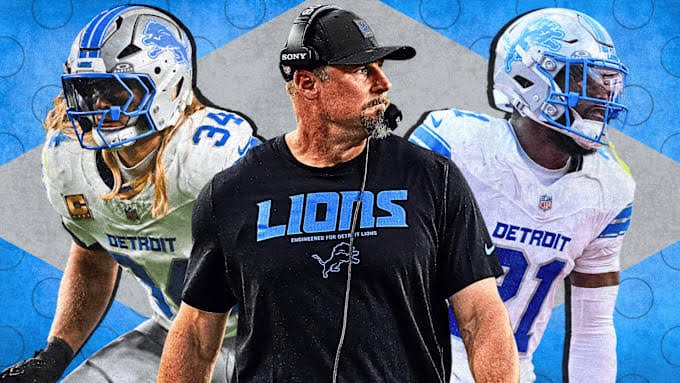
For the Detroit Lions, attention centers on linebacker Jack Campbell and running back Jahmyr Gibbs. Both players have performed well enough early in their careers to validate their first-round selections and could soon position themselves for major contract extensions with the franchise.
The fifth-year option exists only for first-round picks. It gives teams the chance to extend a rookie’s standard four-year contract by one additional season. The salary attached to that extra year depends on a tiered formula that factors in playing time and honors such as Pro Bowl selections.
While the option allows teams to keep talented players under contract longer, franchises still have the choice to negotiate long-term extensions or decline the option altogether and allow the player to reach free agency.
The Lions have used this strategy before. In 2024, the team exercised the fifth-year option on offensive tackle Penei Sewell before rewarding him with a four-year, $112 million extension. At the time, Sewell’s $28 million average annual value set a new benchmark for offensive linemen, although deals for players like Laremy Tunsil, Rashawn Slater, and Tristan Wirfs have since surpassed that figure.
The following offseason, general manager Brad Holmes followed a similar path by extending both Aidan Hutchinson and Jameson Williams after exercising their options.
Because of that recent history, it would not be surprising if the Lions take the same approach with Campbell and Gibbs. Picking up their options would likely be the first step, with longer deals potentially coming afterward.
Campbell has quickly developed into a key figure on Detroit’s defense. After starting 12 games during his rookie campaign, he has started every game over the past two seasons. His 2025 performance marked a career high, as he recorded five sacks, 17 quarterback pressures, and an impressive 176 total tackles, including 89 solo stops. He also added four passes defended and forced three fumbles, recovering two of them.
Those numbers followed a strong 2024 season in which Campbell produced 131 tackles and 1.5 sacks. Analytics site Pro Football Focus gave him an outstanding 90.2 overall grade, ranking second among qualified linebackers. He also received a 71.4 coverage grade and a league-best 93.0 mark for run defense.
With Detroit entrusting Campbell with greater leadership responsibilities on defense—especially after the departure of veteran linebacker Alex Anzalone—it seems very likely the organization will exercise his fifth-year option and eventually work toward a contract extension. The exact value of that option is uncertain, but there are recent comparisons. The Baltimore Ravens previously picked up the option on edge rusher Odafe Oweh for $13.251 million. Several other linebackers, including Devin Lloyd, Quay Walker, Zaven Collins, Jamin Davis, and Joe Tryon-Shoyinka, did not have their options exercised.
Gibbs presents a slightly different case because of how teams traditionally value the running back position. NFL franchises have become cautious about committing large contracts to running backs due to the physical toll of the role and the relative ease of replacing production through the draft.
Despite that trend, Gibbs appears to be an exception. He and Bijan Robinson of the Atlanta Falcons were the only running backs selected in the first round of the 2023 draft. Both players are widely expected to have their fifth-year options exercised and could soon sign lucrative extensions.
Gibbs has been remarkably consistent, averaging at least five yards per carry each season while earning three consecutive Pro Bowl selections. In 2024, he led the league with 16 rushing touchdowns and has recorded back-to-back seasons with more than 1,200 rushing yards. His dynamic ability has made him one of Detroit’s most important offensive weapons.
Given his production, his next contract could exceed $20 million per season, placing him in the same financial tier as top running backs like Christian McCaffrey and Saquon Barkley.
Although many teams remain cautious about heavily investing in running backs due to injury risk and historically short career peaks, Gibbs has demonstrated the type of impact that can justify breaking that rule. Players such as Barkley, McCaffrey, and Robinson have shown that elite talent at the position can still command significant value.
Around the NFL, several teams have already begun making their fifth-year option decisions. Quarterback Bryce Young, the first overall pick in 2023, will earn a guaranteed $26.5 million in 2027 if his option is exercised. C.J. Stroud is set for $25.9 million, Will Anderson Jr. for $21.5 million, and cornerback Christian Gonzalez for $18.1 million.
Meanwhile, wide receiver Jaxon Smith-Njigba of the Seattle Seahawks is slated to earn $23.9 million on his option year and has already secured a four-year extension worth $168.6 million that keeps him with the team through 2031.
For the Lions, the upcoming decisions regarding Campbell and Gibbs will shape the roster’s long-term outlook and highlight how teams manage rookie contracts while keeping their best young players in place.
Some observers questioned why Holmes appeared somewhat restrained in free agency this offseason. However, part of Detroit’s remaining salary cap space is likely being preserved not only for the incoming rookie class but also for future extensions for cornerstone players such as Gibbs and Campbell.