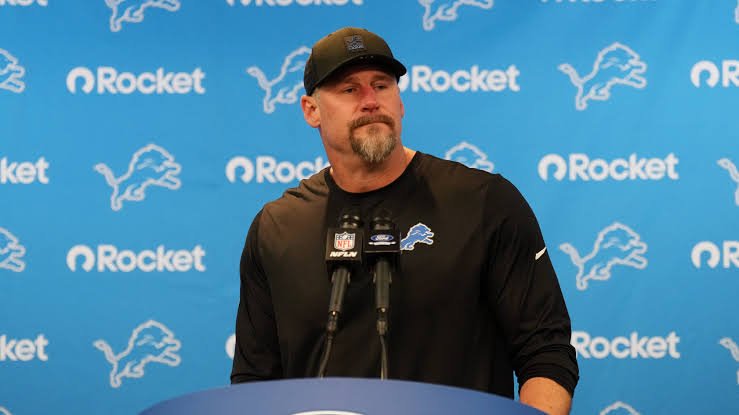
Dan Campbell identifies two key players the Lions will rely on heavily in 2026

The Detroit Lions entered the offseason with a noticeable shift in roster strategy, signaling a move toward a younger core. General manager Brad Holmes parted ways with several veteran leaders who had long served as team captains, including Taylor Decker and Alex Anzalone. As a result, the organization is preparing for younger standouts such as Penei Sewell and Jack Campbell to take on larger responsibilities both on the field and inside the locker room.
Now, it falls on Holmes and head coach Dan Campbell to assemble the right supporting cast around these emerging leaders. Much like Sewell and Jack Campbell once developed behind experienced players like Decker and Anzalone, the Lions are hoping the next wave of talent will grow within the system as well.
In reality, this leadership transition didn’t begin this winter. The organization has been gradually shifting toward its younger core for several seasons. Sewell began asserting himself as one of the team’s most influential players a couple of years ago thanks to his dominant play in the trenches, while Jack Campbell stepped into a defensive leadership role during the previous season.
Despite these developments, Detroit still has considerable work to do this offseason if it wants to build a roster capable of winning the NFC North.
At the start of the offseason, the Lions were hesitant to restructure some of their larger contracts — a common strategy teams use to free up salary-cap space for roster upgrades. Although some adjustments were eventually made, Holmes has yet to address several key needs, many of which may ultimately be filled through the draft.
One of the most pressing concerns remains the pass rush opposite Aidan Hutchinson. The Lions still lack a proven edge rusher on the other side and allowed Al-Quadin Muhammad to sign with the Tampa Bay Buccaneers on an affordable one-year deal worth $6 million. Detroit replaced him with D. J. Wonnum on a one-year, $3 million contract.
While that move saves some money, it could also represent a drop in production. Muhammad finished last season with 11 sacks and 20 quarterback hits, whereas Wonnum recorded only three sacks and four quarterback hits. To be fair, Wonnum is expected to serve primarily as a rotational depth option rather than a direct replacement, meaning Detroit will likely prioritize adding another edge rusher in the upcoming draft.
Another storyline that continues to raise eyebrows involves Decker’s departure. Reports indicated that the Lions were willing to bring the veteran tackle back, but only if he accepted a reduced salary. Instead of negotiating a lower deal, Decker opted to request his release, which the organization granted.
In the weeks since, the situation has appeared somewhat tense. Decker reportedly felt disappointed that the team even suggested a pay cut, although his performance has declined compared to his peak years. While he remains a capable player, he no longer performs at the elite level he once did, leaving Detroit with yet another position to address moving forward.
The Lions also face several concerns in the secondary. Cornerback Terrion Arnold has recently been linked to a troubling robbery investigation in Florida, though the organization has not publicly expressed major concern. Arnold has also struggled to meet expectations since being selected in the first round of the 2024 draft.
Meanwhile, veteran corner D. J. Reed endured a difficult season after joining Detroit to replace Carlton Davis III. Injuries limited his availability, and when he did play, his performance was inconsistent — likely influenced by those physical setbacks.
Detroit’s safety group also carries injury-related uncertainty. Brian Branch is recovering from a ruptured Achilles tendon suffered late last season, which could delay his return until midway through the upcoming campaign. His teammate Kerby Joseph is also dealing with lingering knee concerns, raising questions about how often he will be available next season.
Because of these issues, the Lions may need to significantly reinforce the secondary or at least develop a reliable contingency plan rather than simply replacing Amik Robertson with Roger McCreary and hoping the unit stabilizes.
With several roster uncertainties still unresolved, leadership within the team will be more important than ever. Much of that responsibility will fall on the shoulders of Campbell and Sewell as the Lions move into the 2026 season and beyond.
Detroit’s offseason approach has sparked plenty of debate among analysts and fans alike. Some observers view the roster changes as a positive step forward, while others remain skeptical about whether the team has done enough.
For instance, Ben Solak of ESPN recently ranked the Lions as having the third-most improved roster this offseason, trailing only the Pittsburgh Steelers and the San Francisco 49ers. However, many Detroit fans appear far less convinced about how successful the team’s offseason has truly been.