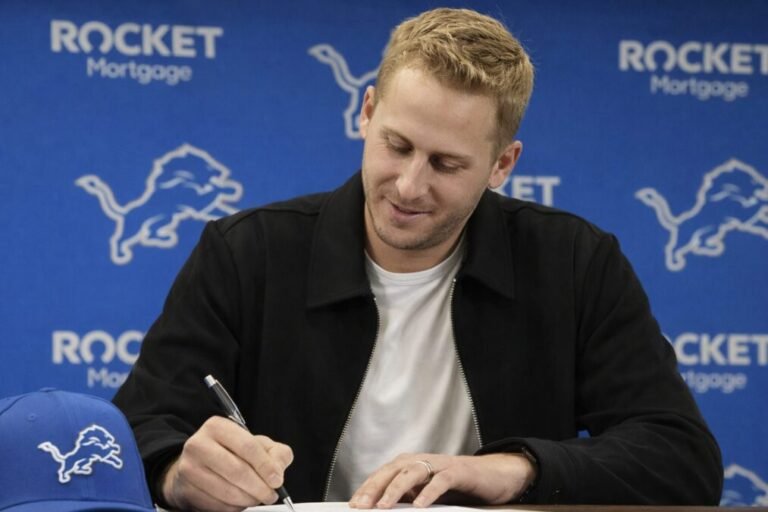
How the Detroit Lions Can Unlock $30+ Million by Reworking Jared Goff’s Contract

As the Detroit Lions look ahead to the 2026 offseason, one financial issue towers above the rest: Jared Goff’s scheduled cap number.
Under the current terms of his contract, Goff is set to carry a $69.6 million cap hit in 2026 — more than one-fifth of the projected salary cap. For a contender trying to maximize a championship window, that figure isn’t just steep, it’s restrictive. The silver lining? Detroit has an obvious and widely used solution that could dramatically reduce that number.
With a straightforward restructure, the Lions can realistically create $30–35 million in cap space without sacrificing roster stability or long-term planning.
Why 2026 Forces Detroit’s Hand
Here’s how Goff’s 2026 contract currently breaks down:
Base salary: $55 million
Prorated bonuses: $14.6 million
Total cap charge: $69.6 million
Moving on from Goff isn’t a viable option. Releasing him would trigger nearly $99 million in dead money, and a trade would still leave Detroit swallowing an enormous financial hit. In short, the Lions are all-in — which makes restructuring the only practical path forward.
The Obvious Fix: Converting Salary Into Bonus
The most logical approach is converting a large portion of Goff’s base salary into a signing bonus. Signing bonuses can be spread evenly across the remaining years of a contract, immediately lowering the cap hit for the current season.
One possible scenario:
Convert $40 million of Goff’s base salary into a signing bonus
Spread it across four remaining years
That results in $10 million per year in prorated charges, creating roughly $30 million in immediate cap relief.
Pushing Further With Void Years
Detroit could take things a step further by adding void years — a tactic commonly used by aggressive contenders. By extending the proration window without extending the player’s actual tenure, teams gain even more short-term flexibility.
If the same $40 million were spread across six years instead of four:
Annual proration drops to roughly $6.7 million
Cap savings climb to about $33 million
This approach has been routinely used by franchises like the Eagles, Chiefs, and Saints when they’re in win-now mode.
Why a Restructure Is Almost Inevitable
Several factors point toward Detroit making this move:
The championship window is wide open. Core players like Aidan Hutchinson, Amon-Ra St. Brown, Penei Sewell, Sam LaPorta, Jahmyr Gibbs, and Brian Branch are all in their prime years.
Goff’s age isn’t a concern. He’ll be 32 in 2026 — firmly within a quarterback’s productive window.
The front office values roster balance. Extra cap space could be used to land a premium edge rusher, a lockdown corner, or reinforce the interior defensive line.
The contract was built for this moment. The inflated base salary in 2026 clearly exists as a future conversion point.
This isn’t cap manipulation — it’s intentional roster design.
What the End Result Likely Looks Like
With a conventional restructure and the addition of one or two void years, Detroit can realistically:
Lower Goff’s 2026 cap hit to roughly $36–39 million
Free up $30–35 million for roster upgrades
Preserve flexibility beyond 2026
Keep the team’s core intact during its Super Bowl push
The Lions don’t have to choose between their quarterback and improving the roster. By reshaping how Goff’s money is allocated, Detroit can aggressively pursue talent while maintaining financial control.
At this point, the only real question isn’t whether the Lions will restructure Jared Goff’s deal — it’s how far Brad Holmes decides to push the accelerator while the window is open. 🦁🏈